
Red Flags and Risk Signals at UK Online Gambling Sites
 Available in GB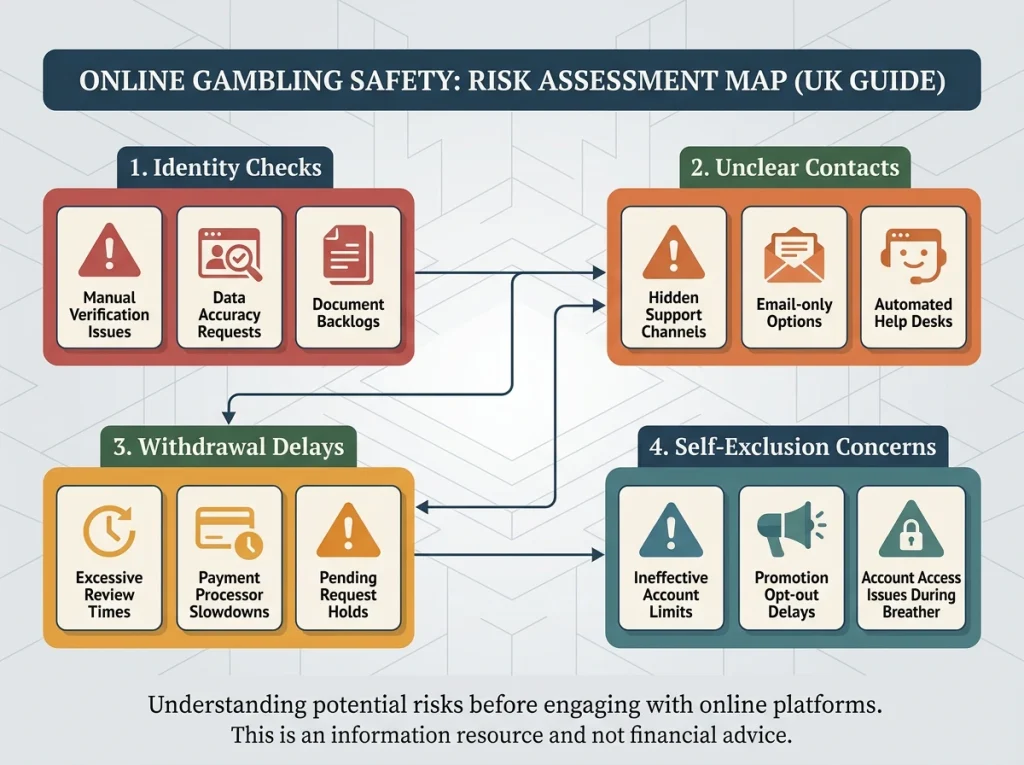
Some gambling websites make risky features look convenient. They may suggest fast access, fewer checks, easier deposits or play outside common restrictions. For a UK reader, those signals should not be treated as benefits. They are reasons to pause, check the official register, read the terms carefully and think about whether safer-gambling protections are being avoided.
This page explains warning signs without turning them into tips for finding or using restricted websites. It does not name operators, rank websites or say that one signal proves a legal result. The purpose is practical: identify patterns that should make you stop before trusting a website with money, documents or personal data.
Risk signs are most useful when read together: identity checks, withdrawal behaviour, contact details and safer-gambling tools all affect the level of concern.
Easy Casino Access as a Major Security Risk Signal
A gambling website that appears to skip age or identity checks may look simple at first, but that simplicity should raise concern. Online gambling businesses are expected to ask for age and identity proof before gambling. If a website lets a customer gamble without normal checks, it may be operating in a way that puts the customer at greater risk. It also leaves the customer exposed later, because documents might be demanded only when a withdrawal is requested or an account is restricted.
Official material on illegal online gambling has recorded several indicators that matter to consumers: no ID or age verification, no deposit limits or self-exclusion tools, site takedowns, unexplained withdrawal difficulty and unresponsive contacts. These are not a checklist for finding access. They are warning signs because they affect whether the business can be identified, whether the rules are clear and whether a customer has a realistic route when something goes wrong.
Self-exclusion and blocked access need especially careful framing. Commission material treats finding a way to gamble while signed up to GAMSTOP and using a VPN to reach a gambling website not available in Great Britain as strong indicators of concern. That is why this page does not explain how to do those things. If those ideas are part of your situation, the safer step is to use support and blocking options, not to test a workaround.
Risk map: what the signal means and what to do next
| Signal | Why it matters | What to check next | What not to do |
|---|---|---|---|
| No age or ID check before gambling | Online gambling businesses are expected to ask for age and identity proof before gambling. | Check whether the business is listed in the Gambling Commission register and read the identity terms before depositing. | Do not treat “no ID” as a benefit or as a promise that documents will never be requested. |
| No clear deposit limit or self-exclusion tools | Missing safer-gambling tools can leave a player with fewer protections when gambling becomes difficult to control. | Look for clear safer-gambling information and consider whether you are trying to avoid a protection already in place. | Do not use the absence of controls as a reason to continue gambling after self-exclusion or harm. |
| Unclear company identity | Unauthorised businesses may use false names, addresses and contact numbers. | Compare the exact domain, business name and trading name with official register information. | Do not rely on a logo, copied address or familiar brand word as proof. |
| Withdrawal difficulty without a clear reason | Unexplained delays, changing document demands or unresponsive support can leave the customer unable to access money. | Save account messages, terms, transaction records and document requests in date order. | Do not keep depositing in the hope that a withdrawal problem will be fixed by more play. |
| Blocked access or repeated takedowns | Site takedowns and access problems can indicate instability or regulatory concern. | Check whether the exact domain is listed officially and whether the business can be identified through reliable routes. | Do not look for alternate access routes simply to keep using the same site. |
| VPN or restricted-market language | Using tools to reach gambling not available in Great Britain is treated as a strong indicator of concern in official material. | Step back and consider whether the site is suitable, licensed for the right market and consistent with any restrictions you have set. | Do not use a VPN, location change or alternate account to get around restrictions. |
| Unresponsive or generic contact details | When a business cannot be contacted clearly, complaints, withdrawals and data requests become harder. | Compare contact details with official information and keep copies of messages you send. | Do not send more documents or money just because an automated message asks for them. |
How to read several signs together
One warning sign should make you slow down. Several warning signs together should make you stop and protect yourself. For example, a website that is not easy to match in the official register, avoids normal ID checks, advertises play outside common restrictions and becomes unclear about withdrawals is not simply “different”. It creates practical risks around identity, account control, money and complaint routes.
Look at the order of events. If a site looks relaxed before deposit but strict only when you request a withdrawal, ask whether the document expectations were clearly explained before you paid. If customer support answers quickly before deposit but becomes slow after a problem, keep the messages and avoid relying on phone calls that leave no record. If a website displays a licence number but the exact domain does not line up, treat the mismatch as unresolved.
Risk signs also affect data. A person may upload passport, driving-licence, bank or source-of-funds information to a gambling website. If the business is hard to identify, you may not know who has received the documents, how they will be used or how to exercise data rights. This is another reason to check identity before sending documents rather than after a dispute begins.
What to do when a warning sign appears
- Pause before the next deposit. Risk signs become harder to manage once more money is involved.
- Check the exact domain in the official register. Use the domain, trading name and business name rather than a badge alone.
- Read the terms that affect money. Look for withdrawal restrictions, customer-funds wording, bonus terms, fees and identity-document timing.
- Keep evidence in date order. Save the website page, terms, account messages, document requests, payment records and any complaint you send.
- Use appropriate official routes. If you suspect unlicensed gambling, money laundering concerns, underage gambling or suspicious activity, the Gambling Commission provides a route for telling it something in confidence. If your problem is a personal withdrawal or account dispute, the complaint route is separate and should be handled in the right order.
- Step toward support if gambling control is part of the issue. A warning sign is not only a business-risk issue. It may also be a sign that gambling is moving around blocks, limits or self-exclusion.
What not to treat as reassurance
A website can look polished and still be hard to verify. A familiar word in a brand name is not the same as a matching business identity. A badge is not the same as a current GB licence. A foreign licence is not permission by itself to provide gambling to consumers in Great Britain. Fast registration is not a promise of fast withdrawal. “No verification” language is not a consumer protection; it can mean the most serious checks are delayed until the customer is already exposed.
Also be careful with advice from chat rooms, adverts or promotional pages that frame restriction avoidance as ordinary choice. When a person has used GAMSTOP, bank blocks or other limits, the purpose is protection. A website that helps the person ignore those protections may be increasing harm even if it sounds convenient in the moment.
A short safety note
If you are looking at unfamiliar gambling websites because you are self-excluded, blocked by your bank, chasing losses or trying to recover money through more gambling, treat that as an immediate reason to stop and seek support. A safer next step may be adding more blocking layers, speaking to a gambling-support service or using money and debt guidance. This page does not provide ways around GAMSTOP, location restrictions, ID checks, payment blocks or safer-gambling tools.
Checks to use after a warning sign
Use the official register check to compare the business and exact domain. Use the payments, ID checks and withdrawals guide before putting money or documents into an account. If a withdrawal, identity check or account closure has already become a problem, go to complaints and disputes. If self-exclusion or gambling harm is part of the situation, use support and protection options.
Once you have assessed the basic safety of an operator, make sure to read our guide on payments, ID checks and withdrawals to avoid unexpected delays later.
For a secure and tested gaming experience, explore the top-rated platforms featured at Gamstop Free Slots.
Questions about warning signs before trusting a site
Should I trust a site because it says “no ID check”?Does one warning sign prove a website is illegal?Should I use a VPN if the site is blocked or unavailable?