
Resolving Casino Withdrawal Disputes and ID Check Problems
 Available in GB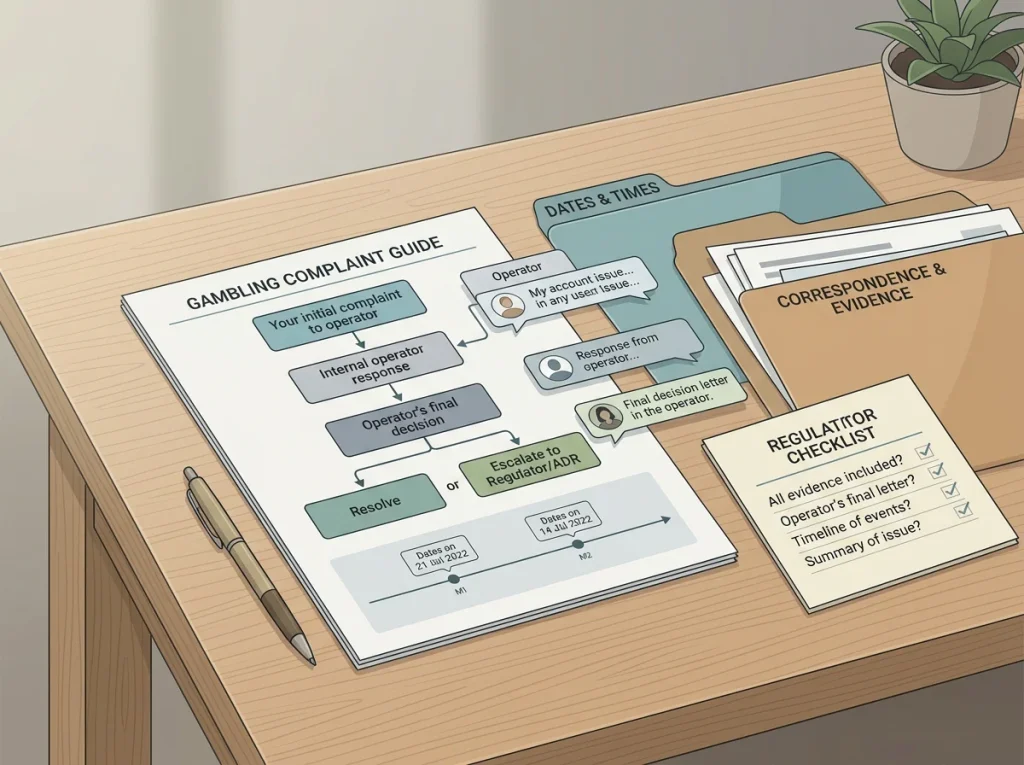
A gambling dispute can feel urgent because money, documents and access to an account may all be involved at the same time. A withdrawal may have slowed down after an identity request, an account may have been closed after a terms review, or a bonus rule may have changed what you expected to receive. The right next step is not to send angry messages, make another deposit or rely on a forum answer. It is to separate the issue, keep evidence and use the correct complaint route.
This guide is for a UK reader who already has a problem with a gambling account. It does not promise that money will be recovered, that a payout can be forced or that every complaint will succeed. It explains how to organise the facts, where the Gambling Commission fits, when the business must be approached first and when an independent dispute route may become relevant.
A dispute is easier to handle when the issue, evidence, dates and complaint route are separated before escalation.
Identifying the Root Cause of Casino Payment Disputes
Do not start by trying to prove every possible fault at once. Gambling complaints often sit in a few broad groups: payment management, terms and conditions, bonus offers, identity verification, account closure, cancelled bets, IT problems and customer service. Your case may involve more than one of these, but the complaint should still begin with the main issue.
If the problem is a delayed withdrawal after document requests, write that down as the main issue. If the account was closed and funds are being withheld, make the closure and the balance treatment central. If the dispute is about a bonus, focus on the exact promotion terms, when you opted in and what the operator says you did or did not meet. A complaint that changes subject every few lines is harder for the business, an adviser or an independent reviewer to follow.
Keep emotional impact in the background but do not let it replace facts. It is reasonable to say that the dispute is causing stress, especially where rent, debt or self-exclusion is involved. It is still more useful to provide dates, account messages, screenshots, transaction records and terms than to make broad accusations that cannot be checked.
What evidence to keep
The Gambling Commission’s public guidance tells users to check terms, contact the business, follow the business complaints policy and keep evidence. Evidence should be kept before you edit, delete or close anything. Some websites remove old account messages, live-chat transcripts or offer pages, so save what you can while it is visible.
- Save the date and time of the disputed deposit, bet, withdrawal request or account message.
- Keep screenshots of the account balance, withdrawal status, verification request and any closure notice.
- Copy the terms and conditions that the operator says apply, including bonus terms if a promotion is involved.
- Keep payment records, receipts, bank references and wallet references, but do not publish private data publicly.
- Save emails and chat transcripts in full, not only the sentences that support your position.
- Record the business name, trading name and website domain so the complaint is tied to the correct operator.
- Keep a simple timeline showing what happened first, what you sent, what the business asked for and what remains unresolved.
Evidence is not about overwhelming the business with a large bundle. It is about making the dispute understandable. A short timeline with accurate documents is stronger than a long message that mixes anger, guesses and repeated claims.
A practical decision path
- Name the issue. Decide whether the dispute is mainly about a withdrawal, identity check, account closure, bonus term, cancelled bet, payment problem, IT issue or customer service failure.
- Collect the record. Keep terms, screenshots, messages, document requests, payment records and the exact website identity. Do this before sending repeated messages.
- Read the relevant terms. Check the rule the business is relying on. If the wording is unclear, quote the exact wording and ask how it applies to your account.
- Complain to the business first. The Gambling Commission does not decide individual gambling transaction complaints. The starting point is the gambling business and its complaints procedure.
- Follow the complaint policy. Use the operator’s stated route, include your evidence and ask for a written response. Keep the tone factual so the issue can be reviewed.
- Track the eight-week period. The business has eight weeks to resolve a complaint from receipt. Record the date your complaint was received, not only the date you first felt something was wrong.
- Look for a deadlock or final outcome. If the business reaches a final position before the eight weeks, save that response. It may affect whether the dispute can move to an independent route.
- Consider ADR if the route is available. After eight weeks or a deadlock outcome, a user may be able to take the complaint to an Alternative Dispute Resolution provider. ADR is described as free and independent.
- Use the Commission’s intelligence route for different concerns. If you suspect unlicensed gambling, money laundering concerns, underage gambling or suspicious activity, that is not the same as asking the Commission to decide your transaction complaint.
Complaint route comparison
| Situation | Best first route | Evidence to prepare | What not to expect |
|---|---|---|---|
| Withdrawal delayed after documents | Complain to the gambling business through its complaints process. | Withdrawal request, document request, documents sent, dates, messages and terms about verification. | Do not expect the regulator to access your account or release the money for you. |
| Account closed with funds disputed | Ask the business for the reason, the terms relied on and the balance treatment in writing. | Closure notice, balance screenshot, account history, terms and any previous warnings or requests. | Do not assume account closure alone proves the business is wrong or right. |
| Bonus or promotion disagreement | Use the operator complaint route and quote the exact promotion terms. | Offer page, opt-in record, wagering or eligibility terms, account messages and transaction history. | Do not rely on a headline offer if the written terms say something narrower. |
| Payment or balance mismatch | Contact the business first and keep payment records. | Bank or wallet reference, deposit receipt, account balance screenshot and any fee wording. | Do not make extra deposits just to test whether the payment route works. |
| Suspected unlicensed or suspicious activity | Keep evidence and consider the Commission’s confidential reporting route. | Domain, business identity, messages, payment details and the reason you believe the activity is suspicious. | Do not treat a confidential report as a way to get a personal transaction decision. |
What the Gambling Commission can and cannot do for a transaction complaint
The Gambling Commission is the regulator for gambling in Great Britain, but its role is not the same as a customer-service department or a court. The Commission’s public guidance says it does not resolve or decide gambling-related transaction complaints and that users should complain directly to the gambling business first. It also explains that a common enquiry is the inability to withdraw winnings, but the Commission does not have access to customers’ accounts.
This boundary matters because sending the wrong issue to the wrong place can delay useful action. If your problem is that a licensed business has not answered your withdrawal complaint, the business complaint route and, later, the ADR route may be relevant. If your concern is that a website may be unlicensed, is using false details or is involved in suspicious activity, that is a different kind of information for the regulator.
When you contact any route, keep the request narrow. “Please decide my complaint immediately” is less useful than “This is the date my complaint was received, this is the issue, this is the evidence, and this is the current status.” A narrow request makes it easier to see whether the eight-week period, deadlock response or reporting route applies.
Writing the complaint without making it weaker
A strong complaint is clear, chronological and calm. Start with your account identifier if you have one, the website domain, the main issue and the outcome you are asking the business to explain. Then set out the timeline. Use dates rather than words such as “ages” or “forever”. Quote the exact term the operator has used. If you do not understand the term, ask for a written explanation rather than guessing.
Avoid threats, invented legal claims and statements that cannot be proved. Do not say that the business is criminal, insolvent or deliberately stealing unless you have reliable evidence and advice to support that wording. Do not publish private documents or account details in public comments. A complaint can be firm without becoming reckless.
If the dispute is about documents, say what was requested, what you sent, when you sent it and whether the business replied. If the dispute is about a bonus, say which bonus, when you accepted it and which written rule is being relied on. If the dispute is about account closure, ask for the reason, the status of any balance and the route to challenge the decision.
After eight weeks or deadlock
The business has eight weeks to resolve a complaint from receipt. After eight weeks, or after a deadlock outcome, a user may be able to take the complaint to an Alternative Dispute Resolution provider. The public guidance describes ADR as free and independent. That does not mean ADR will always accept every issue or decide in the customer’s favour. It means there may be a route outside the operator once the business process has reached the relevant point.
Before using ADR, organise the file. Put the complaint, the operator’s replies, the terms, the evidence and the timeline in a sensible order. Remove duplicate screenshots and keep the clearest version. If you changed the complaint during the process, explain why. The aim is to help an independent reviewer understand what decision is being challenged.
Do not restart the clock by sending a new complaint every few days unless there is genuinely new evidence. Keep a record of when the first formal complaint was received and what the operator did after that.
When support is part of the dispute
A money dispute can become more harmful if it leads to more deposits, borrowing or chasing losses. If you are repeatedly depositing while trying to solve a withdrawal issue, pause before sending more money. If self-exclusion, bank blocks, debt or distress are part of the situation, the dispute should not be treated only as an account problem. It may also need support and protective steps.
Support does not weaken a complaint. It helps protect you while the complaint runs. If gambling is causing problems, the NHS lists support options, and GamCare runs the National Gambling Helpline. The verified helpline number is 0808 8020 133. If there is immediate danger or a mental-health crisis, use urgent local support rather than waiting for a gambling complaint outcome.
Routes after payment or ID disputes
If you are still deciding whether to trust a website, use the official register check and the warning signs guide before sending money or documents. If the problem is about payment wording, ID checks or withdrawal terms before deposit, read the payment and verification checklist. If self-exclusion, bank blocks or harm are involved, read support and protection options.
If your financial issues are causing distress, you should understand what to do when self-exclusion or bank blocks are part of the situation.
Return to our comprehensive guide on non Gamstop casino sites to find operators with transparent and fair payment policies.
Questions before raising a gambling complaint
Can the Gambling Commission force a withdrawal for me?When can ADR become relevant?Should I deposit again while waiting?