
UK Gambling Commission Official Register and Domain Checks
 Available in GB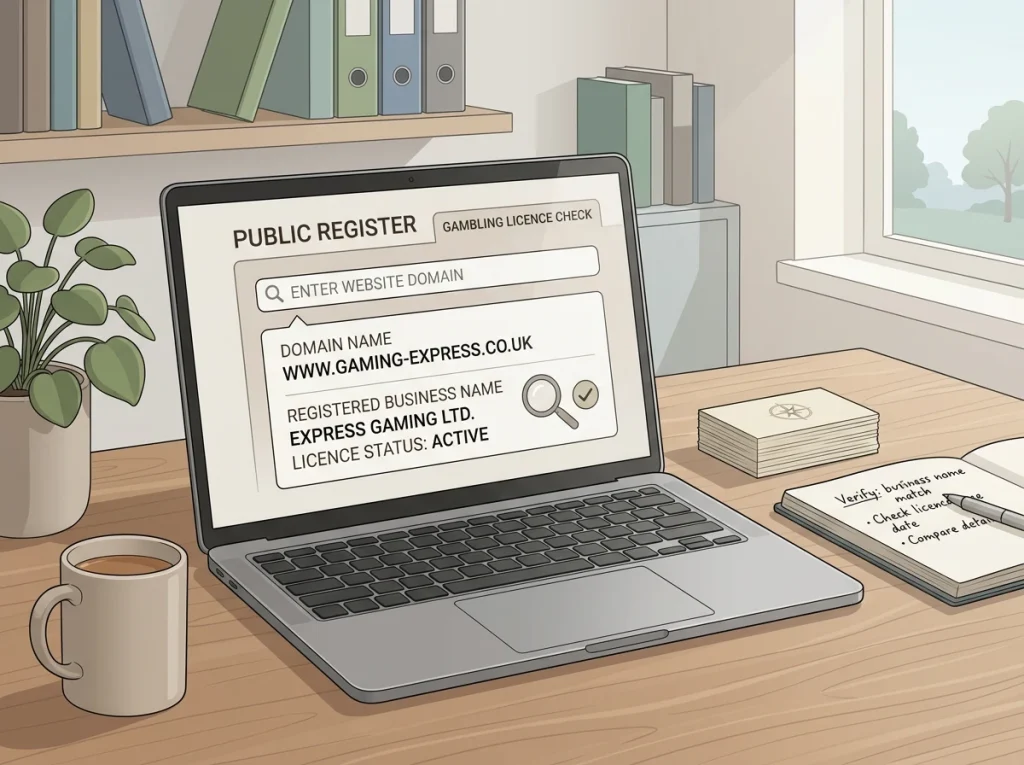
When a gambling website presents itself as available to UK players, the first useful check is not a slogan, badge or claim on the website. It is the official public register held by the Gambling Commission. The register lets you look up licensed businesses by business name, trading name, domain name or account number. That matters because an unfamiliar gambling website can show a brand name that differs from the company behind it, or it can display details that are incomplete, copied or hard to connect to the actual domain you are visiting.
This page explains how to make that check in a careful way. It does not verify any named operator, does not recommend any gambling site and does not say that a match automatically makes a website risk-free. The aim is narrower: help you compare the domain, business identity and licence information before you trust a website with money, documents or personal data.
A useful check compares the exact website domain with the business and trading-name information, rather than relying on a logo or short licence claim.
Verifying Official Casino Licenses Before Depositing Real Money
In Great Britain, online gambling is regulated through the Gambling Commission. The Commission’s public register is the official place to check licensed businesses, licence status and related public regulatory information. It also publishes registers and datasets covering licensed businesses, people, regulatory actions and premises. A gambling website’s own footer may still be useful as a starting point, but it is not enough on its own because the website controls that text.
The difference between a regulated operator and an unverified website is especially important when the phrase “not on GAMSTOP” appears. GAMSTOP explains that online gambling companies licensed in Great Britain must be part of GAMSTOP Online. A website outside that coverage may therefore raise questions about whether it is GB licensed, whether it is targeting the right market and whether a self-excluded person is being drawn toward gambling that safer-gambling tools were meant to block. That does not mean every website can be judged from one phrase, but it does mean the official check should happen before any deposit.
A foreign gambling licence should also be treated carefully. The Gambling Commission explains that a foreign gambling licence does not permit an operator to provide gambling to consumers in Great Britain. A licence badge from another country is not the same thing as being licensed for the GB market. If a website leans on a foreign licence while presenting itself as suitable for GB consumers, pause and check the register rather than assuming the badge answers the question.
What to collect before you look up the site
Start with details that can be copied exactly. Small differences matter. A brand may use one name on a home page, another name in terms and conditions and a different company name in a payment receipt. Domains can also be similar without being the same. Write down the full domain shown in the address bar, not only the brand name. If the website lists a company name, trading name, licence number, account number or registered address, save those details as well.
Do not treat screenshots as proof that the information is true; they are just a record of what you saw. Unauthorised gambling businesses may use false names, addresses and contact numbers. That is why the point of collecting details is to compare them against official information, not to give the website the benefit of the doubt.
- Copy the exact domain without adding or removing words.
- Note the brand name and any trading name shown in the footer or terms.
- Note the company name, licence number or account number if the website gives one.
- Save the page where those details appear, especially if you have already deposited money or submitted documents.
- Keep payment receipts and account messages separate from marketing emails, because they may show a different business identity.
A practical register-check path
- Open the Gambling Commission public register. Use the official register rather than an article, forum post or advert. The register can be checked by business name, trading name, domain name or account number.
- Start with the exact domain. Domain-name matching is important because a copied company name or a similar brand name may lead you to the wrong business. If the exact domain does not appear, try the trading name and business name separately.
- Compare the business identity. Look at whether the business name and trading name connect naturally to the website you are checking. A match on one word is not enough if the rest of the information points somewhere else.
- Check licence status and public regulatory information. The register includes licence status and regulatory actions. A page may also show domains or trading names supplied by businesses. The Commission notes that third-party accuracy is not guaranteed, so read the information cautiously rather than treating every entry as a personal endorsement.
- Compare contact details with care. If the website gives a contact number or address, compare it against official information where available. Mismatched or generic details are not a reason to continue; they are a reason to slow down.
- Record uncertainty instead of filling gaps. If a name, domain or account number cannot be matched, write down exactly what failed to match. Do not turn that uncertainty into a legal conclusion, but do not ignore it either.
What to compare
| Check | What you are comparing | Why it matters | Sensible next step |
|---|---|---|---|
| Exact domain | The address in your browser against domains listed in the official register. | A similar-looking domain can point to a different website or a copycat operation. | If the exact domain is not clear, do not deposit while trying to make the result fit. |
| Business name | The legal name behind the site against the business shown in the register. | A brand can be marketed under one name while another company holds the licence. | Check whether the business identity and website terms point to the same operator. |
| Trading name | The brand used publicly against the trading names listed for the licensed business. | Trading names help connect a consumer-facing brand with the licensed business. | Look for an exact and current connection, not just a familiar word. |
| Licence status | The current status shown in the register. | A historic or suspended connection is different from a current licence. | Read the status and any public regulatory information before deciding what to do. |
| Regulatory actions | Public action attached to the business where shown. | Regulatory action may affect how you judge the risk of trusting the operator. | Read it in context and avoid making claims beyond what the official entry says. |
| Website claims | Footer badges, licence numbers and contact details against official records. | Unauthorised businesses may use false names, addresses and contact numbers. | Treat mismatches as a reason to pause, keep evidence and use official routes. |
What a match can and cannot prove
A register match can help you understand whether a business is licensed and whether the domain or trading name appears to connect with that business. It can also show public status information and public regulatory actions. Those checks are useful, but they do not promise that every transaction will be smooth, that withdrawals will be instant, that every term is fair in your situation or that gambling is a good idea for you.
A register check is one part of a wider decision. Before depositing, you may still need to read the customer-funds information, ID and document requirements, withdrawal terms, bonus restrictions, privacy notice and complaint route. If the website is already difficult to identify, the later checks become more important, not less. A person should not have to guess who holds their money or who receives their identity documents.
The check is also not a way to get around self-exclusion. If you are signed up to GAMSTOP, the important question is not how to find a different route to gamble. The safer question is what support or additional blocking layers may help you keep the protection in place. For that reason, this page treats GAMSTOP absence as a risk context, not as a feature.
If the details do not match
If the domain, company name or licence details do not line up, avoid turning the gap into a guess. You may not know whether the website is impersonating a business, using outdated details, operating outside GB licensing or simply presenting information badly. The practical response is the same: do not rely on it until the official information is clear.
- Stop before adding money or documents if the identity is unclear.
- Keep screenshots, receipts and messages if you have already interacted with the site.
- Use the official register and official contact routes rather than a contact method supplied only by the website.
- Read warning signs alongside the register result, especially if the site avoids age or identity checks, has vague terms or becomes unresponsive.
- Do not assume a foreign licence, copied badge or familiar brand word gives permission to serve GB consumers.
If you suspect unlicensed gambling or suspicious activity, the Gambling Commission provides a route for telling it something in confidence. That route is different from resolving a personal complaint, but it can help the regulator receive information about suspected unlicensed activity.
You can always find reliable alternatives and detailed reviews on the best UK casinos not on Gamstop main page.
Related checks after the register
The register is the identity check. It should be followed by risk, payment and support checks where relevant. If the site makes unusual claims about verification, withdrawals or access, read the warning signs before trusting a gambling website. If your next concern is whether to deposit, read the payments, ID checks and withdrawals checklist. If self-exclusion, gambling blocks or harm are part of the reason you are looking, go to support and protection options rather than trying to find a way around those protections.
Before making any deposits, it is highly recommended to learn about the warning signs before trusting a gambling website to protect your personal data and funds.
Questions about licence and register checks
Does a licence badge on a website prove it is safe for UK users?Should I rely on the brand name or the exact domain?Can the register method confirm one named website for me?